




The setup
Through Austin Energy's Solar Standard Offer program, announced last fall, businesses and property owners are incentivized to either install their own solar panels or lease rooftop space to solar developers. In exchange, they're compensated by the utility based on energy generated by the new panels.
Power produced on properties under Solar Standard Offer is sold into AE's system, contributing to civic renewable goals and boosting the local grid capacity. Richard Genece, AE vice president for customer energy solutions, called the program a "game-changer."
“As a public power utility, Austin Energy has the ability to design local solutions for local needs including this unique solar program. We’re turning commercial rooftops into commercial revenues, and doing it in a way that benefits all customers and the environment," AE General Manager Stuart Reilly said.

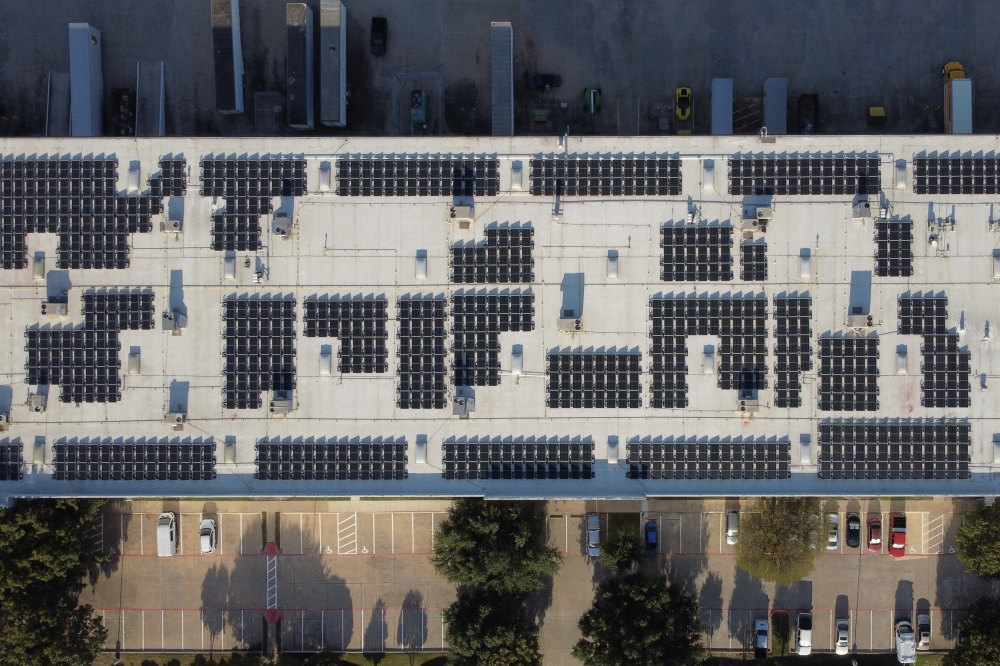
City and business leaders gathered in Northeast Austin on Dec. 3 to mark the completion of the inaugural Solar Standard Offer project.
Hundreds of solar panels are now in place atop two buildings in the Tuscany Crossing industrial business park. The 812 warehouse rooftop panels can generate roughly 660,000 kilowatt-hours annually, enough electricity to power about 70 homes, according to AE.

“You start a virtuous cycle where we’re investing in our community with good wages, clean energy and making sure that Austin has the electricity that it needs to power our lives," he said of the program.

In other news
While encouraging private properties to back new solar projects, Austin is also moving ahead on a plan to bring solar panels to dozens of public facilities around town.
The city already has some solar panels on airport parking garages and the Palmer Events Center, but officials hope to expand those investments around the city. Back in the spring, they backed a plan from council member Ryan Alter to review the potential for solar installations on all city-owned buildings, parking lots and open spaces.
“Solar has proven to be one of, if not the cheapest, option for power generation. So if we are able to deploy solar at a large scale, that is going to keep rates as low as possible for customers," Alter said in May.
About 120 of more than 250 city facilities under consideration were deemed feasible for future solar installations, city staff announced in December. They're now moving to issue a public solicitation for the initiative—a process city representatives hope to complete as quickly as possible given expiring federal support for renewable energy development.
The approach
Under the reconciliation package passed this summer, originally titled the One Big Beautiful Bill Act, federal tax credits for clean power projects will no longer be available after July 4, 2026. That change is coming despite a national surge in new solar installations over the past decade-plus, and means Austin's plans to add solar on city buildings must move forward by the summer.
Zach Baumer, director of Austin Climate Action and Resilience, told City Council the project may not be financially viable without those credits.

Austin would still remain eligible for the federal tax credits if at least 5% of the value of all proposed projects is spent by Independence Day.
“This is our one shot really, unfortunately," Alter said Dec. 2. "I wish we had more opportunity, more time, but with urgency comes action, hopefully."
What to expect
Austin's list of possible project locations wasn't provided by AE or the city climate office as of press time. Estimates on public benefits from the installations also aren't available without locations finalized, although Baumer pointed to positive results from similar solar projects in other cities.
Staff believe about 75 city-owned facilities could end up being involved, with solar installations there bringing a combined 25 MW to AE's system. One megawatt-hour can power an estimated 250 homes during times of peak demand, according to the Electric Reliability Council of Texas.
It also remains to be seen whether new panels will be fully owned by the city—identified as a riskier option with higher potential savings for AE—or by third parties under the lower-risk Solar Standard Offer model. Costs and benefits will depend on the chosen ownership model, according to AE, although both options come with positive projections.
“We are not going to know the real details on how much this is going to cost or what the payback is going to be until we get our bids back in the coming months, but our initial financial modeling shows a potential positive net present value to the city," Baumer said. "The initial running of the numbers shows that this should be a positive to the city, and should pay back and save us money over the long term.”
The push for more solar arrays comes as AE has already significantly grown its capacity over recent years.
The utility reported adding nearly 19 MW across hundreds of projects last fiscal year alone, and now stands at 188 MW of total local solar capacity. AE has a goal of reaching 205 MW by 2027.